



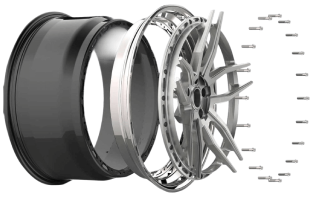
 Modern design
 Perfect fit
 High durability
 Free shipping within 24 hours
 Individual project
 Dedicated specjalist


EU tire labels
In 2009, the European Commission began work on reducing energy consumption by 20% by 2020. As part of this program, a labeling system was created to inform European Union citizens about the energy consumption levels of household appliances and electronics, as well as tires for passenger cars, vans, and trucks. Since 2012, every tire sold in the 28 member states must include clear information on energy efficiency, wet grip, and driving noise levels.
Energy efficiency / rolling resistance
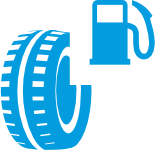
During driving, tires deform due to contact with the road surface. This creates rolling resistance, which leads to energy loss and, consequently, increased fuel consumption. This rolling resistance can account for up to 20% of a vehicle's total fuel consumption.
Reading the label
The label is divided on a scale from A (green) to G (red), where A is the highest class, ensuring low fuel consumption, while G is the lowest class, with relatively high fuel consumption. In the case of passenger car tires , the D class is omitted.
Fuel consumption and class level
The difference between a set of class A tires and a set of class G tires can be as much as 7.5%. Assuming the car travels 10,000 km per year, consumes an average of 8 liters per 100 km, and costs PLN 5.50 per liter, this translates into savings of around PLN 330. A new tire driven 10,000 km per year will last for approximately four years, resulting in a total savings of PLN 1,320.
Wet grip

This is a crucial factor when choosing new tires, impacting safety while traveling. Braking distances vary for each tread, so the introduction of labels significantly aids in tire selection. In critical situations, a difference of just a few meters can make a huge difference.
Reading the label
As with energy efficiency, the scale is divided from class A (best) to G (worst), with classes D and G not included for passenger cars.
Braking distance and class level
The difference between A- and F-class tires when braking on wet roads at 80 km/h can be as much as 18 meters. This is a distance of about six vehicle lengths.
Noise level

This is the external noise generated by tires when driving at 80 km/h. Noise levels are measured in decibels using microphones positioned on both sides of the test track. The test is conducted under standardized conditions, on a roadway compliant with the ISO 10844 standard.
Reading the label
Noise levels are indicated by black waves. Three waves indicate noise levels that comply with current European Union regulations. Two waves indicate noise levels that comply with future European standards. One wave indicates a noise level that is 3 dB below the future limit. Additionally, each label also has a numerical designation.
Difference in noise level
Decibels are a logarithmic unit of measurement. This means that even a small change in their value causes a huge difference in the noise generated. In fact, a difference of 3 dB means twice as much noise.