



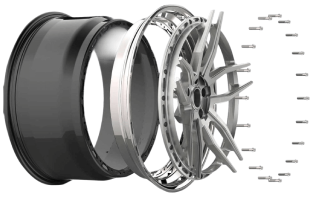
 Modern design
 Perfect fit
 High durability
 Free shipping within 24 hours
 Individual project
 Dedicated specjalist






How many millimeters of tread does a new tire have – how deep are the grooves?
Tread depth is one of the most important parameters determining how car tires perform on the road. The grooves in the tread are responsible for evacuating water, maintaining traction, and shortening braking distances—especially on wet surfaces. It's no wonder, then, that drivers often ask: how much tread does a new tire have and whether all new tires offer the same value in millimeters.
In practice, the answer isn't as obvious as it might seem. The tread depth of a new tire depends on its type, intended use, and tread design. Summer tires have different values, winter tires have different values, and all-season or sports tires have different values. Differences can be as small as a few millimeters, which directly impacts traction, aquaplaning resistance, and overall tire performance.
In this article, we'll explain the typical tread depth of a new tire, what determines its value, and the differences between different tire types. We'll also look at current regulations regarding minimum tread depth and practical methods for measuring it. This will make it easier to assess tire condition and ensure safety during everyday driving.

How many millimeters of tread does a new tire have – standards and market differences
Many drivers assume that every new tire has the same tread depth. In practice, this isn't the case. Tire manufacturers use different tread designs, which depend on the tire's intended use, class, and technical parameters. Therefore, the answer to the question of how many millimeters a new tire has won't always be the same.
Most often, the tread depth of a new tire falls within a certain range that allows for a balance of good handling, durability, and ride comfort. However, it's worth remembering that even a few millimeters of difference can affect the vehicle's performance on wet roads and the rate of tire wear.
Manufacturers' standards and the intended use of the tire
Most new tires have a tread depth of around 7 to 10 mm . This is typical for tires designed for passenger cars used in everyday use.
However, several factors influence the exact value. One of these is the tire's segment . Premium manufacturers often design their treads to provide an optimal balance between traction, durability, and noise levels. Budget models may have a slightly shallower tread or a simpler design.
The intended use of the tire also matters. Sporty models, designed for dynamic driving at high speeds, often have shallower tread. This increases the tire's contact area with the asphalt, improving stability and steering precision. Tires focused on comfort and safety in challenging conditions may have deeper grooves that evacuate water more effectively.
The tread depth of a new tire is also influenced by parameters such as speed rating, tread design, and vehicle segment. Therefore, even among tires of the same size, differences of up to several millimeters can be found.
Minimum tread depth according to law and safety
In Poland, regulations clearly define the minimum permissible tread depth. According to applicable law, tread wear cannot exceed 1.6 mm. Below this value, the tire is considered technically unsound, and driving on such tires may result in a fine and confiscation of the vehicle's registration certificate.
It's worth remembering, however, that this is only the absolute minimum required by road traffic regulations, not a value that ensures optimal safety. Automotive experts and tire manufacturers recommend replacing tires much earlier.
For summer tires, it's recommended that the tread be at least 3 mm , while for winter tires, the safe limit is around 4 mm . Below these values, traction deteriorates significantly, especially on wet surfaces or in winter conditions.
Therefore, although the tread depth of a new tire can be as low as 8–9 mm, it's worth checking its wear regularly. This helps maintain a high level of safety and the full performance characteristics of modern car tires.
Tread depth of a new winter tire – why is it the deepest?
Of all tire types, winter tires typically have the deepest tread. This isn't a coincidence, but rather a result of their design adapted to challenging road conditions—snow, slush, and low temperatures. In such situations, the tire's ability to "bite" into the road surface and effectively wick away moisture from beneath the contact patch is crucial.
Therefore, the tread depth of a new winter tire is significantly higher than that of most summer tires. More rubber and deeper grooves help maintain vehicle stability on slippery surfaces and improve control when braking or starting in snow.
The specificity of winter tires and their construction
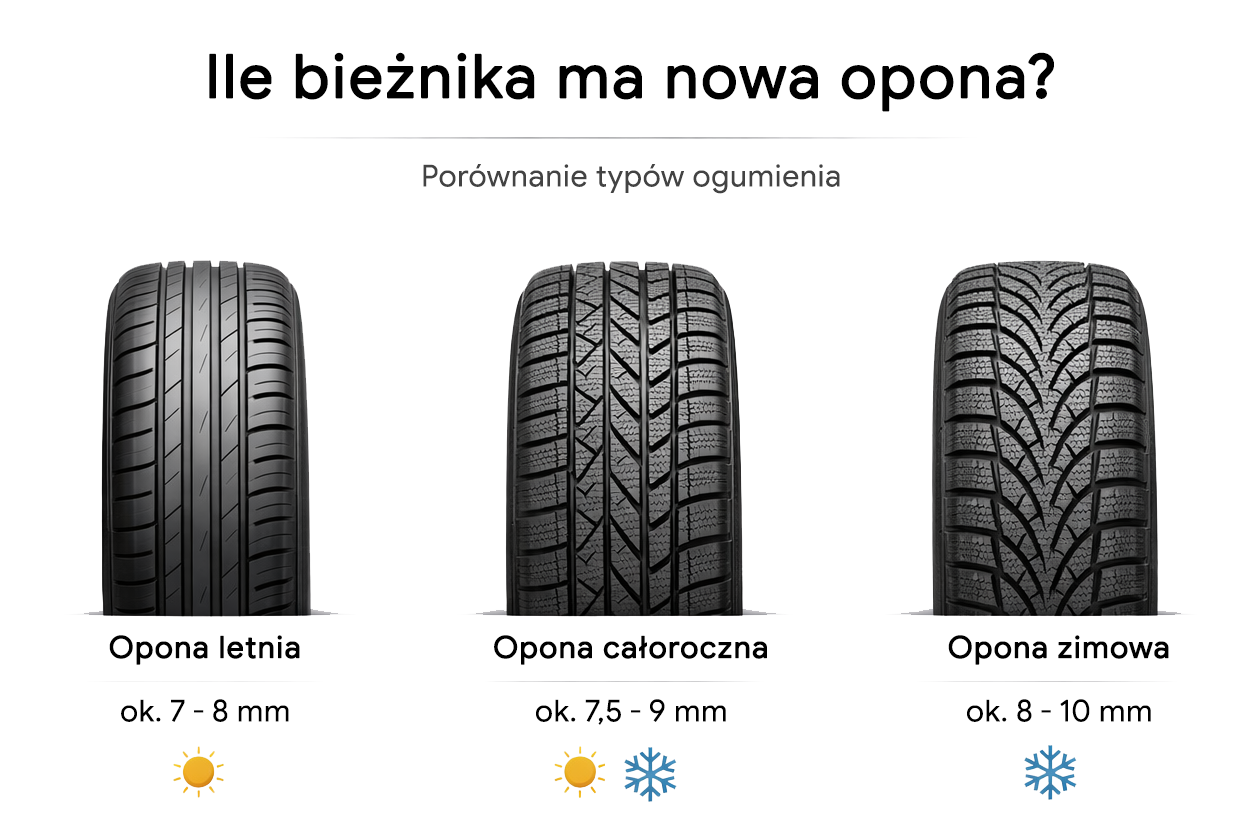
The typical tread depth for a new winter tire is typically around 8 to 10 mm . Some models designed for particularly challenging winter conditions may have a slightly higher tread depth.
This significant tread depth is primarily due to the tire's construction. Winter tires feature a large number of tiny cuts, called sipes . These sipes make the tread more flexible and better able to adapt to uneven surfaces.
The sipes act as small edges gripping the ground. When driving on snow, they open up and "bite" into the snow's structure, increasing traction. At the same time, deep tread grooves effectively evacuate slush and water , reducing the risk of skidding and loss of control.
This allows a properly designed winter tire tread depth to maintain good traction even in challenging winter conditions. This is why experts recommend replacing winter tires much earlier than legally permitted – ideally when the tread depth approaches approximately 4 mm. Below this value, the tire loses a significant portion of its performance on snow and ice.
How much tread does a new summer tire have – a balance between stability and rain?
Summer tires are designed for completely different road conditions than winter tires. In warmer months, handling stability, good grip on dry asphalt, and effective water drainage in wet conditions are paramount. Therefore, the tread pattern on summer tires is usually slightly shallower and stiffer than that of winter tires.
This is why the tread depth of new summer tires differs from that of winter tires. A shallower tread depth helps increase the tire's contact patch with the road, resulting in better stability at higher speeds and more precise handling.
Optimal depth for summer tires
How many millimeters of tread does a typical new summer tire have? In most cases, it's around 7–8 mm . This value is a compromise between good grip on dry roads and effective water evacuation when driving in the rain.
A smaller tread depth compared to winter tires isn't a disadvantage. On the contrary, tire designers deliberately design the tread of summer tires to make the tread blocks more stable and less susceptible to deformation. This allows the tire to respond better to steering movements, and the car to handle more confidently during dynamic driving.
Additionally, the shallower tread helps reduce tire heat buildup when driving in high temperatures. This is especially important at highway speeds, where stability and steering precision are crucial for safety.
This doesn't mean, however, that the tread depth of summer tires can be very shallow. The grooves still need to effectively evacuate water from under the wheels to reduce the risk of aquaplaning . Therefore, even with a tread depth of around 7–8 mm, modern car tires maintain very good traction on both dry and wet surfaces.
What is the tread on new all-season tires – the golden mean?
All-season tires, also known as all-season tires, are increasingly being chosen by drivers who want to avoid seasonal tire changes. Their design offers a compromise between the properties of summer and winter tires. This also applies to one of the key parameters: tread depth.
When it comes to tread depth on new all-season tires, it's typically in the range of around 7.5–9 mm. This is a mid-range value between summer and winter tires. This allows an all-season tire to maintain a reasonable level of grip in both hot summer weather and mild winter conditions.
All Season Tire Construction
Modern all-season tires are designed to cope with a wide range of weather conditions. Therefore, their tread design is more complex than that of typical all-season tires.
The typical tread depth for an all-season tire is around 7.5–9 mm . Manufacturers strive to optimize the groove depth and tread block shape to ensure the tire provides good summer stability while also being able to handle moisture, slush, and light snow.
The tread of all-season tires often combines elements typical of both types of tires. On the one hand, it has relatively wide grooves that evacuate water, similar to those found in summer tires. On the other hand, the tread structure also includes sipes that improve traction on slippery surfaces and at lower temperatures.
Thanks to this construction, all-season tires maintain an intermediate tread depth. This allows for a compromise between durability, driving comfort, and safety throughout the seasons. However, it's important to remember that while all-season tires are highly versatile, in extreme conditions—both in hot weather and deep snow—season-specific tires still offer the best performance.
How to measure tread depth yourself and read markings?
Regular tread inspection is one of the simplest maintenance tasks that every driver can perform themselves. This allows you to quickly determine whether your car tires still provide adequate traction and whether they are still safe to drive. Measuring them doesn't require specialized knowledge or expensive equipment—often, a few minutes and a simple tool are enough.
It's important to remember that tread wear isn't always uniform. Therefore, measurements should be taken at several locations around the tire's circumference and in various tread grooves. This allows the driver to quickly detect irregularities, such as uneven wear resulting from incorrect suspension geometry or incorrect tire pressure.
Where to find the TWI (Tread Wear Indicator)?
The easiest way to check the condition of your tire is to look for the TWI (Tread Wear Indicator) . This is a small mark located in the tread grooves that indicates the minimum allowable tread depth.
On the sidewall of the tire—the shoulder—you'll find a small marking in the form of the letters TWI, a triangle, or an arrow. This indicates where a small bridge of rubber is located within the tread. If the tread surface aligns with this indicator, the tire has reached the minimum allowable value of 1.6 mm and should be replaced.
It is worth remembering, however, that although a tire's TWI index shows the legal limit, safety experts recommend replacing tires earlier – especially in the case of winter tires, where the appropriate tread depth is crucial for traction in snow.
Home remedies and professional measuring tools
The most accurate way to check tread depth is to use a special depth gauge. This is a small measuring tool that can be purchased at automotive stores for just a few zlotys. Both simple manual models and more precise electronic versions are available. Simply insert the tip of the gauge into the tread groove to read the exact value in millimeters.
If a driver doesn't have such a tool on hand, they can perform a quick check using a coin. A popular method is to use a 2 złoty or 5 złoty coin. By inserting it into the tread groove, they can roughly assess whether the tire is still at safe tread depth. While not as accurate as measuring with a gauge, it allows for a quick check of the tire's millimeter depth and how much wear it has experienced over time.
Regularly checking your tread depth is one of the simplest ways to improve driving safety. This allows drivers to plan tire replacements in advance and avoid tire loss during rain or sudden braking.
Why might a new tire have less tread than before?
Just a dozen or so years ago, many drivers noticed that new car tires often had very deep tread—often exceeding 9–10 mm. Today, these values are slightly lower in some models. However, this is not a sign of inferior product quality, but rather a result of technological changes and the growing emphasis on energy efficiency and environmental friendliness.
Tire manufacturers are increasingly designing tires to be lighter, generate lower rolling resistance, and consume less fuel. One element of this strategy is optimizing tread design. In practice, this means that the tread depth of new tires in some models may be slightly lower than in older designs, but at the same time, the rubber compound itself is more advanced and more durable.
“Eco” tires and modern rubber compounds
In recent years, the segment of so-called eco-friendly tires , often referred to as Eco or Energy , has experienced significant growth. Their primary goal is to reduce rolling resistance, which translates into lower fuel consumption and lower CO₂ emissions.
One way to achieve this is to reduce the initial tread depth. Some summer tire models now have values around 6.5–7 mm , which is slightly less than traditional designs. Less rubber translates into lower tire weight and less deformation during driving, which directly impacts rolling resistance.
At the same time, manufacturers are using increasingly advanced rubber compounds that are more resistant to abrasion. This allows the tire to maintain excellent durability over time, despite its reduced initial tread depth.
In practice, this means that the tread depth of a new tire is no longer the only determinant of its quality or service life. Modern technologies allow us to design tires that provide good traction, a high level of safety, and, at the same time, improved fuel efficiency.
Frequently Asked Questions (FAQ)
- summer tires – approx. 7–8 mm of tread,
- winter tires – approx. 8–9 mm tread.
- the minimum permissible tread depth in Poland is 1.6 mm ,
- the recommended replacement of summer tires occurs at approx. 3 mm ,
- for winter tires the limit is approximately 4 mm .
- the measurement is performed in several places across the width of the tire,
- the most important thing is the result at the most used point ,
- you should not rely only on the center or only on the side.
Mateusz Mentel
Author of the entryHe has been associated with LadneFelgi.pl since 2024. He specializes in aluminum wheels and modern automotive solutions. His day-to-day responsibilities include creating expert articles, marketing activities, content creation, and managing social media channels.