



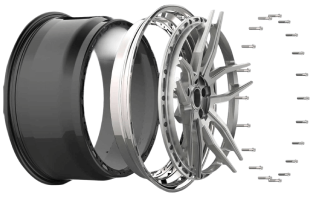
 Modern design
 Perfect fit
 High durability
 Free shipping within 24 hours
 Individual project
 Dedicated specjalist





What are flow-forming rims? An innovative method of producing rims.
Flow forming is an innovative technology revolutionizing the production of aluminum rims. It enables the creation of lightweight rims with exceptional strength and excellent performance. In this article, we'll explore what flow forming is, how rims are created using this technology, and why this production method is superior to traditional counterparts.
What is flow forming technology? Discover the revolution in rim production.
Flow forming is a process in which a pre-cast wheel is heated and then formed on special rollers under high pressure. This stretches and compacts the material, improving its structure and strength. The result is flow-formed wheels that are lighter and stronger than traditionally cast wheels.
This technology allows for a weight reduction of up to 25% compared to standard production methods. This lightweight flow-formed rims improve vehicle performance, reduce fuel consumption, and provide better handling. This is why more and more car manufacturers and tuning enthusiasts are choosing to use this technology for rims.
An additional advantage of flow-formed rims is their aesthetic appeal. This process allows for the creation of more complex patterns and details , which translates into an attractive final product. These rims are not only functional but also elegant, which is appreciated by drivers who care about the style of their vehicles. This argument is often decisive in discussions about which rim production method is best.
How are flow-formed rims made? A step-by-step walkthrough of the innovative process.
Flowforming wheel production begins with the initial casting of an aluminum wheel core. The core is then heated to the appropriate temperature to prepare it for forming. This step is crucial to the entire process, as proper heating of the material ensures its plasticity and ease of processing.
After heating, the aluminum wheel is placed on special rollers that form its shape under high pressure. This uniformly stretches and compacts the material, improving its structure. This process produces flow-formed wheels, characterized by high strength and low weight.
The final stage is finishing, which includes polishing, painting, and protecting the rims against corrosion. Thanks to this, the production of aluminum rims using flow-forming technology guarantees not only excellent technical parameters but also the aesthetic appearance of the final product. Once this process is complete, the rims are ready for installation on vehicles, ensuring driver comfort and safety.
Why Are Flow Formed Rims Lighter? The Secrets to Reducing Weight Without Sacrificing Strength
Flow-formed rims are lighter than not only steel rims but also other alloy rims. This is achieved through a unique production process that reduces the material's weight while simultaneously increasing its strength. Heating and forming under high pressure makes the aluminum structure more uniform and compact, allowing for reduced weight without sacrificing strength.
Another secret is the precise stretching of the material, which allows for even distribution of forces throughout the entire rim structure. This makes lightweight flow-formed rims resistant to mechanical damage, such as cracks and deformation. This makes them an ideal choice for both sports cars and everyday driving.
Flow forming technology also enables the creation of rims with more complex designs. This allows for further weight optimization, ultimately resulting in improved vehicle performance and reduced fuel consumption. Flow forming is the future of rim production, combining innovation, durability, and aesthetics.
Are flow forming rims the golden mean between cast and forged rims?
Flow-forming rims combine the advantages of both cast and forged rims. They inherit the ability to create more complex designs from cast rims, and the strength and low weight of forged rims. This makes them an ideal compromise for drivers seeking lightweight, high-strength rims.
Cast wheels are typically cheaper to produce, but their durability is lower compared to forged wheels. Forged wheels, on the other hand, are very durable, but their production is more complex and expensive. Flow forming combines the best of both methods, offering high quality at a reasonable price.
It's also worth noting that flow-forming rims are more eco-friendly, as their production process consumes less energy and materials. This makes them environmentally friendly, a feature increasingly important to modern consumers. Flow-forming is a technology that meets the needs of not only drivers but also car manufacturers.

From racing to everyday driving – applications of flow forming rims
Flow-formed rims are used in both racing cars and everyday vehicles. Their strength and low weight make them an ideal choice for athletes who need reliable, high-performance rims. Flow-forming produces rims that withstand extreme conditions and deliver excellent performance on the track.
Flow-forming rims also perform exceptionally well for everyday driving. They make the vehicle more dynamic, reduce fuel consumption, and significantly improve ride comfort. Furthermore, these rims are aesthetically pleasing and add a modern look to the car, which is appreciated by many drivers.
Flow-forming rims are also widely used in tuning. Thanks to their ability to create complex patterns and details, these rims are often chosen by car enthusiasts who want to give their vehicles a unique character. Flow-forming is a technology that combines functionality with aesthetics, making it an ideal choice for a wide range of applications.
Will you feel the difference behind the wheel? Performance and flow-forming rims
Drivers who choose flow-forming rims often report a significant difference in vehicle performance. Lightweight rims improve the car's acceleration and agility, which is especially important for dynamic driving. By reducing unsprung mass, the vehicle is more responsive and responds better to steering inputs.
Reducing wheel weight also has a positive impact on fuel consumption – cars equipped with flow-forming wheels are more fuel-efficient . Lower fuel consumption means lower CO2 emissions, consequently contributing to a reduced carbon footprint.
It's also worth noting that flow-forming rims improve driving comfort . Their durability and ability to absorb shocks provide a smoother ride, even on uneven surfaces. This, in turn, makes them an ideal choice for drivers who value both performance and ride comfort.
Flow forming is an innovative rim production method that combines the advantages of cast and forged rims. This allows for lightweight, high-strength, and attractively designed rims. These rims are used in both sports racing and everyday driving, offering improved vehicle performance, lower fuel consumption, and greater driving comfort. Therefore, it's worth investing in flow forming rims and enjoying all the benefits of this modern technology.
Recommended

4x rims 18 for SEAT Ateca CUPRA Born Leon VZ Cup VZx Formentor VZe VZ VZ5 - I5572 (FBX220)

4x rims Kute Flow Forming 19 for TESLA model 3 3 FL Standard MID Long Range - YS214 (H3117F)


