



 Modern design
 Perfect fit
 High durability
 Free shipping within 24 hours
 Individual project
 Dedicated specjalist









Are winter tires mandatory in Poland? Regulations, fines, and exceptions.
Every autumn, the same question resurfaces among drivers: are winter tires mandatory in Poland? As temperatures drop and the first snow falls, discussions about seasonal tire changes, regulations, and potential penalties begin. Many people have heard of fines for driving with summer tires in winter, while others believe that winter tires are required by law. However, the reality is more complex, and many myths have arisen around the topic.
Polish law does not explicitly require drivers to change their tires to winter tires within a specific timeframe. This means that, formally, a ticket for not having winter tires does not constitute a separate offense. However, this does not mean complete discretion. In practice, tire replacement is regulated indirectly – through the obligation to maintain the vehicle in a condition that ensures road safety.
This aspect is crucial. In some situations, driving with summer tires in winter can be considered a road hazard. In such cases, the driver may face consequences – both during a roadside inspection and when the insurer settles a claim.
In this article, we explain in detail the regulations regarding winter tires in Poland, whether they are mandatory, when the police can impose a fine, and why the right tires are crucial for road safety.
Obligation to change to winter tires in Poland – what exactly do the regulations say?
The topic of mandatory winter tire replacement has been a source of much confusion among drivers for years. Some believe that Polish law clearly defines the date from which winter tires must be used – similar to many European countries. Others, however, argue that summer tires can be used year-round without any consequences. But what's the reality?
To answer this question, we need to refer to applicable regulations and the principles of Road Traffic Law. Contrary to popular belief , Polish law does not explicitly impose a seasonal tire change obligation . However, this does not mean that drivers have complete freedom in choosing tires in all conditions.
The general principle that a vehicle participating in road traffic must be maintained in a condition that ensures road safety is crucial. In practice, this means that choosing the right tires can make a real difference during a roadside inspection or in the event of a collision.
Below we explain in detail what the regulations regarding winter tires in Poland say, how to interpret the provisions of the Highway Code and in what situations a driver may be obliged to use additional winter equipment.
The Highway Code and winter tires – legal status for 2024/2025
Under current Polish law , there is no regulation mandating the use of winter tires within a specific calendar period . Unlike many European countries, Polish law does not specify specific dates, such as November 1st – April 15th, during which drivers must use winter tires.
This means that, under Polish law, the winter tire requirement is not a direct statutory requirement . Therefore, a driver can theoretically drive on summer or all-season tires in winter, provided the vehicle meets the general technical requirements for roadworthiness.
Polish law treats tires in a rather general way. According to the Road Traffic Act, a vehicle must be equipped with tires that:
- ensures adequate grip,
- does not pose a threat to traffic safety,
- has the required minimum tread.
The minimum tread depth in Poland is 1.6 mm , but in practice, automotive experts emphasize that this value is definitely insufficient for safe driving in winter.
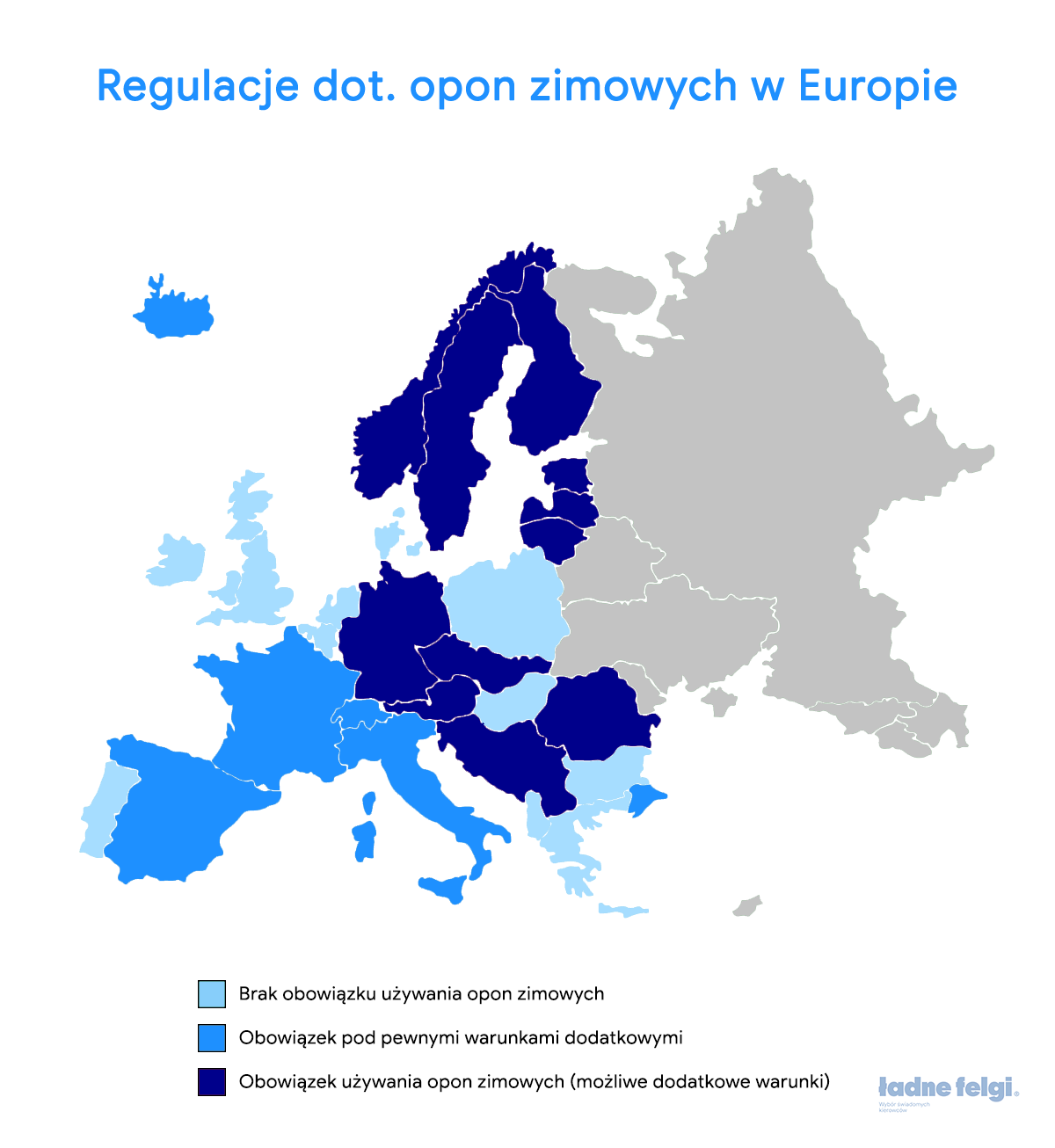
It's also worth noting that, in Europe, Poland is one of the few countries where winter tire regulations aren't clearly defined . Many EU countries—including Germany, Austria, the Czech Republic, and Slovakia—require the use of winter tires under certain conditions or at specific times.
Polish lawmakers have therefore given drivers greater freedom in choosing tires. At the same time, the responsibility for properly preparing the vehicle for winter conditions rests directly with the driver.
When do winter tires (or chains) become mandatory? Sign C-18
While there's no general requirement to use winter tires in Poland, there are situations where drivers must adapt their vehicle's equipment to road markings. One such example is sign C-18, which requires the use of snow chains .
The C-18 sign informs drivers that chains must be fitted to at least two drive wheels on a given section of road. In practice, such markings are found primarily in mountainous regions, where winter road conditions can be particularly challenging.
It is worth emphasizing that the use of chains is only permitted when:
- the road surface is covered with snow or ice,
- weather conditions actually justify their use.
If a C-18 sign is displayed on a road, drivers are required to follow its instructions. Driving without chains on a section marked with such a sign may result in a fine.
In practice, this also means that driving on summer tires in mountainous regions in winter is very risky. Even if winter tires aren't formally required by law, the combination of snow, steep inclines, and road markings can necessitate the use of additional equipment .
Therefore, drivers planning winter trips to the mountains should always take into account the possibility of the C-18 sign appearing and prepare the vehicle for driving in difficult winter conditions.
Can you get a ticket for not having winter tires? Legal pitfalls
The lack of a statutory requirement to drive on winter tires in Poland often leads to the erroneous conclusion that drivers face no consequences for driving on summer tires in winter. In practice, the situation is different. Although the law does not specifically provide for a "fine for not wearing winter tires," drivers may be penalized in other situations – especially if the condition of their tires or driving behavior poses a risk to other road users.
Polish road traffic law requires drivers to maintain their vehicles in a technical condition that ensures safe road travel. If tires don't meet basic requirements or the driver is unable to continue driving in difficult winter conditions, the police have the right to intervene and issue a fine.
In practice, this means that although there is no penalty for driving with summer tyres in winter, there may be indirect legal consequences arising from road safety regulations.
Ticket for the technical condition of tires - this is what the police will pay attention to
During a roadside inspection, a police officer primarily assesses the technical condition of the tires , not their type. This means that an officer cannot issue a ticket solely for driving on summer tires in winter. However, they can impose a fine if the tires do not meet basic technical requirements.
The most frequently checked elements are:
- tread depth – in Poland the minimum permissible value is 1.6 mm,
- visible tire damage such as cracks, bulges or cuts,
- uneven tread wear that may affect vehicle stability.
If the tread is worn below the permitted level, the driver may receive a ticket for a bald tire and the vehicle will be deemed technically unroadworthy.
In such a situation, the police officer has the right to:
- impose a fine for the technical condition of the vehicle,
- retain the registration certificate until the fault is rectified,
- prohibit further driving of the vehicle if the condition of the tires poses a hazard.
In practice, this means that even if a driver does not formally break the regulations regarding seasonal tires, driving on worn or damaged tires may result in serious financial consequences.
“Obstructing traffic” and creating a hazard – summer tires in a snowstorm
The second situation in which a driver may be penalized despite not being obliged to use winter tires is obstructing or blocking road traffic.
Imagine a typical winter scenario – heavy snowfall, icy roads, and a steep incline. A car equipped with summer tires could have significant difficulty starting or climbing the hill. If the driver is unable to continue driving and blocks other vehicles, the police may consider this a misdemeanor.
In such a case, the driver may receive a ticket for obstructing traffic, even if the direct cause of the problem is inadequate tires.
Similar situations most often occur when:
- the car cannot start on a snow-covered road,
- the vehicle blocks the lane while trying to climb a hill,
- the driver loses control of the vehicle and obstructs other road users.
In practice, driving on summer tires in snow may lead to real legal consequences, although they do not result from a direct ban on the use of such tires.
For this reason, many experts emphasize that the absence of a legal obligation does not mean a lack of responsibility. Properly preparing your car for winter conditions is not only a matter of driving comfort, but above all, road safety – both for yourself and other drivers.
Winter tires and insurance – will you get compensation?
For many drivers, the most important argument for seasonal tire replacement isn't a ticket or roadside inspection, but the potential financial consequences in the event of a collision or accident. In practice, the question of winter tires and insurance arises frequently—especially in winter, when road conditions deteriorate rapidly.
It's worth noting that the impact of tire type on compensation payment depends primarily on the type of insurance policy. Different rules apply to compulsory third-party liability insurance (OC) and voluntary comprehensive insurance (AC). It's in AC policies that provisions appear that can have a real impact on the insurer's decision.
Therefore, drivers should be aware that although there is no formal obligation to use winter tires in Poland, the lack of appropriate tires in difficult road conditions may, in certain situations, complicate the claim settlement process.
Third-party liability insurance and driving with summer tires in winter
In the case of compulsory third party liability insurance, the rule is relatively simple - the insurer must pay compensation to the injured person , regardless of the tires used by the perpetrator of the accident.
Third-party liability insurance primarily protects victims of road accidents and collisions. This means that if a driver causes damage and their vehicle was equipped with summer tires for winter, the insurer is still obligated to cover the costs of repairing the injured vehicle or pay appropriate compensation.
Therefore, in most situations, the answer to the question of whether the insurer will pay compensation when the perpetrator was driving on summer tires in winter is – yes, as far as third party liability insurance is concerned.
This doesn't mean, however, that the lack of winter tires is completely irrelevant from an insurance perspective. In extreme cases, when the driver's behavior is deemed grossly irresponsible, the insurer may attempt to pursue recourse, i.e., reimbursement of some costs from the perpetrator. However, such situations are rare and require very serious circumstances.
Auto Casco (AC) and the concept of "gross negligence"
The situation is much more complicated in the case of voluntary comprehensive auto insurance. In this case, the provisions contained in the General Terms and Conditions of Insurance (GTC) play a key role, defining the precise rules for the insurer's liability.
Many comprehensive insurance policies include the concept of gross negligence , which can be grounds for refusing compensation or significantly limiting it. In practice, this means that if a driver causes damage in a clearly irresponsible manner, the insurer may deem them to have contributed to the event.
In the context of winter road conditions, one example of such a situation would be driving on summer tires during heavy snowfall or on icy roads. If the analysis of the incident reveals that the lack of appropriate tires contributed to the damage, the insurer may invoke provisions regarding gross negligence.
As a result, a situation may arise in which the driver will be refused compensation from AC or will only receive part of it.
Therefore, before the winter season, it's worth not only ensuring you have the right tires, but also carefully checking the terms of your insurance policy. In many cases, properly selected winter tires and comprehensive insurance can have a real impact on a driver's financial security in the event of a collision or accident.
Why is it worth changing your tires, even though you don't have to? The Voice of Reason
Although there's no statutory obligation to change tires seasonally in Poland, the vast majority of automotive experts agree – physics can't be circumvented by regulations . Tires are the only part of a car that comes into direct contact with the road surface. Their properties determine traction, vehicle stability, and braking performance.
Therefore, the decision to change tires should not be based solely on regulations, but primarily on road conditions and temperature. In practice, this means that drivers considering when to change tires should consider weather conditions rather than the calendar date.
Modern tires are designed for a specific temperature range. As road conditions begin to change—especially in autumn and winter—the differences between summer and winter tires become very apparent.
The magic limit of 7 degrees Celsius – when does rubber lose its properties?
One of the most frequently cited rules in the automotive world is the so-called 7-degree Celsius limit . It's around this temperature that the differences between summer and winter tires begin to become apparent.
Summer tires are designed for high temperatures and dry or wet surfaces. Their rubber compound is relatively hard, providing stability and good traction in warmer conditions. However, problems arise when temperatures begin to drop.
At temperatures below approximately 7°C:
- the rubber compound of the summer tire begins to harden,
- the tire loses its elasticity and ability to adapt to the road surface,
- traction on wet or slippery roads decreases significantly.
In extreme cases, rubber can behave almost like plastic – it becomes stiff and has much less ability to “bite” into the surface.
Winter tires, on the other hand, are made from a completely different compound. They contain more natural elastomers and silica, which allows them to:
- remain flexible even at low temperatures,
- they adapt better to road irregularities,
- provide higher traction on snow and ice.
That's why many experts emphasize that the tire replacement temperature should be around 7°C. When the average daily temperature begins to regularly drop below this level, it's worth considering switching to winter tires.
Braking distance on snow and ice – the numbers don't lie
The most compelling argument for seasonal tire changes is specific braking distance data. The differences between summer and winter tires in challenging conditions can be significant.
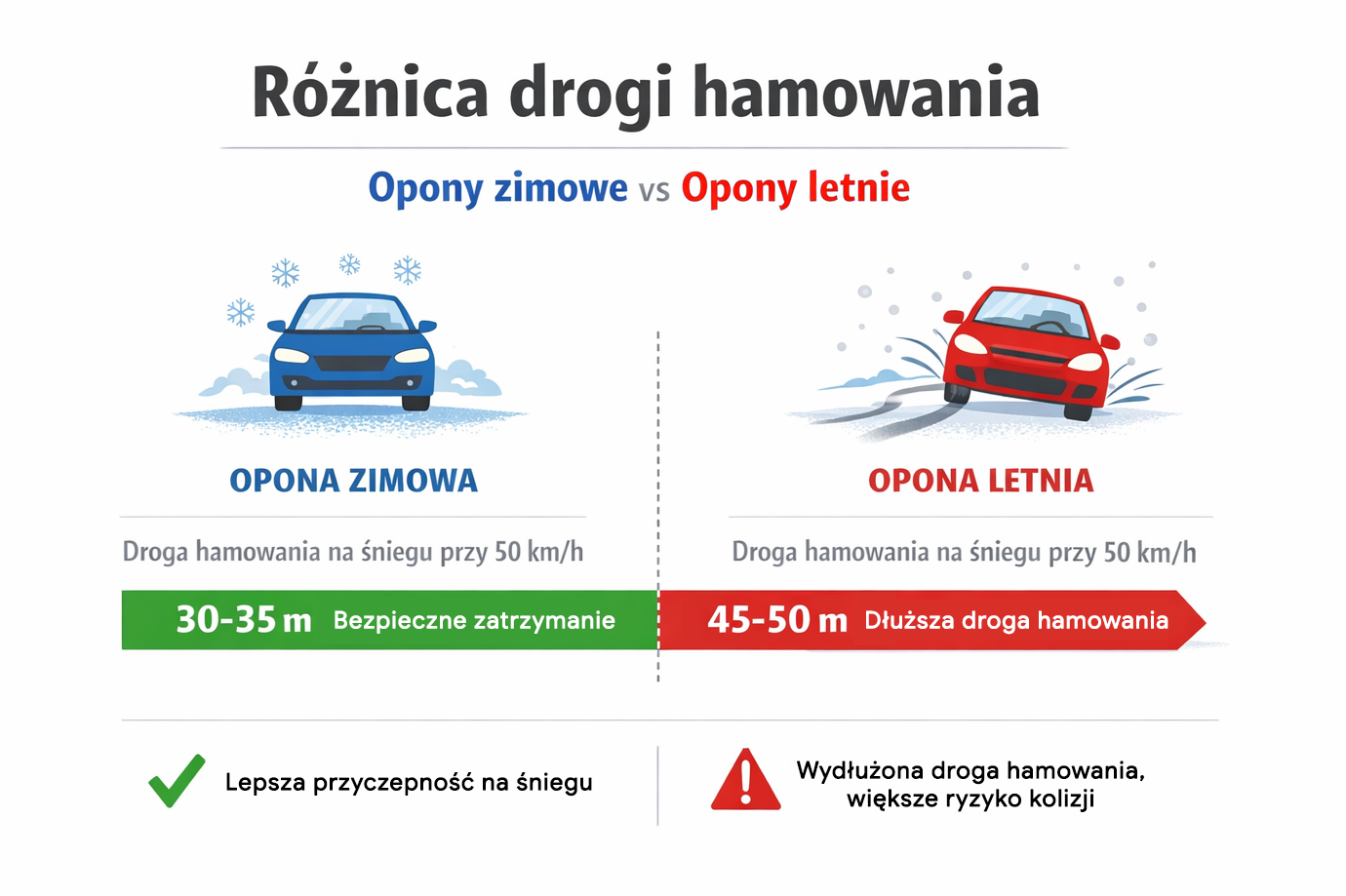
Tests carried out by automotive organizations and tire manufacturers show that at a speed of around 50 km/h on a snow-covered surface, a car equipped with winter tires can stop up to several meters earlier than a vehicle with summer tires.
For example:
- a car with winter tires stops after about 30–35 meters ,
- the same vehicle on summer tires may need up to 45–50 meters .
In practice, a difference of just a few meters often translates to the length of several cars. In an emergency, this distance can be crucial to whether a collision occurs or whether the driver can safely stop the vehicle.
Even greater differences appear on ice or in slush conditions, where the appropriate tread of a winter tire helps to evacuate snow and water from under the wheels.
That's why experts emphasize that seasonal tire replacement isn't just about driving comfort, but above all, winter driving safety. The right tires can significantly improve vehicle control and reduce the risk of accidents—especially when other drivers, pedestrians, or your own family are on the road.
Going abroad – where are winter tires mandatory?
The lack of winter tire requirements in Poland may come as a surprise to many drivers when crossing the border into another European country. In most EU countries, regulations are much more stringent and clearly define when winter tires should be used.
For drivers planning a winter trip—especially to the mountains or skiing—knowing these regulations is crucial. Fines for not having the right tires can be hefty, and in some countries, police may even ban you from driving.
Therefore, before traveling, it is worth checking what the tire requirements are in Europe and what requirements apply in countries neighboring Poland.
Regulations in Germany, the Czech Republic, Slovakia and Austria
In many European countries, the use of winter tires is explicitly regulated by law. Importantly, this requirement can take various forms – sometimes depending on weather conditions, and sometimes on specific calendar dates.
For example:
Germany applies what's known as a situational obligation. This means that drivers must use winter tires whenever wintry road conditions—snow, ice, slush, or frost—are present. Driving on summer tires in such conditions can result in a fine and penalty points.
The Czech Republic is introducing a seasonal requirement. In many regions, winter tires are required from November 1st to March 31st if weather conditions indicate the possibility of snow or ice.
Slovakia has a similar policy. Passenger cars are required to have winter tires when there is snow or ice on the road. For trucks, the requirement is seasonal.
Austria is one of the countries with very strict regulations. From November 1st to April 15th, drivers are required to use winter tires in wintry road conditions. Alternatively, snow chains are permitted if the road surface is covered with snow.
In many of these countries, failing to fit the correct tires can result in hefty fines, often ranging from tens to hundreds of euros. If a driver causes an accident with the wrong tires, the fine can be even higher.
Therefore, people traveling by car in winter should remember that the regulations regarding winter tires in Germany, the Czech Republic or Austria are much more restrictive than in Poland.
3PMSF (Alpine Symbol) marking – why is M+S no longer enough?
In addition to the obligation to use winter tires, the tire marking, which confirms its properties in difficult winter conditions, is becoming increasingly important.
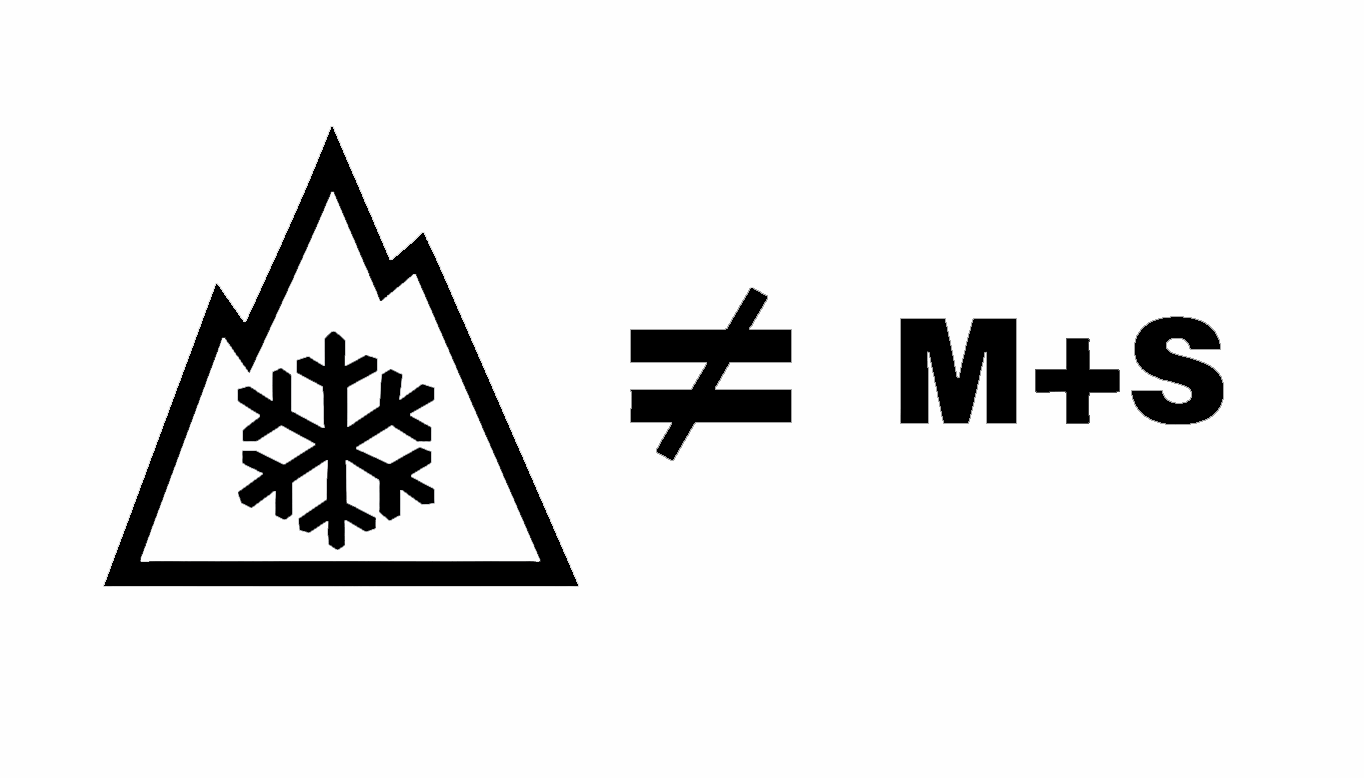
The most important symbol is the 3PMSF marking , which represents a snowflake with three mountain peaks in the background. It's also often called the Alpine symbol . Tires with this marking have undergone special tests to confirm their traction in snow.
Just a few years ago, many winter tires were marked only with the M+S (Mud and Snow) symbol. The problem is that this marking did not require passing standard grip tests and in practice could also be used on tires with limited winter properties.
Therefore, in many countries – including Germany – regulations have been tightened. Currently, tires with the Alpine symbol 3PMSF are required for winter driving conditions, and the M+S marking alone is often no longer considered sufficient.
In practice, this means that drivers traveling abroad should ensure their tires are properly marked. This information is easily visible on the tire sidewall.
Choosing tyres with the 3PMSF symbol ensures that the tyre meets European standards for driving in winter conditions – which can be important for both safety and compliance with regulations in other countries.
Frequently Asked Questions (FAQ)
Mateusz Mentel
Author of the entryHe has been associated with LadneFelgi.pl since 2024. He specializes in aluminum rims and modern automotive solutions. His day-to-day responsibilities include creating expert articles, marketing activities, content creation, and managing social media channels.

