



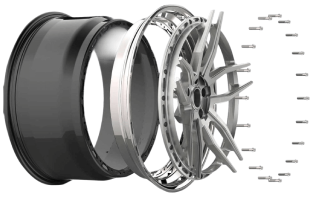
 Modern design
 Perfect fit
 High durability
 Free shipping within 24 hours
 Individual project
 Dedicated specjalist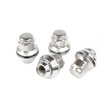






Uncomfortable vibrations on the steering wheel.

Who among us isn't familiar with the vibrations felt through the steering wheel while driving, typical of a damaged tire or unbalanced wheels? Almost anyone who spends more than a few hours a month behind the wheel, whether shopping at the supermarket or taking the kids to the pool, knows all too well how uncomfortable it is to drive with a vibrating steering wheel. What causes this condition? Can it be quickly resolved? What are the potential consequences? And what should you pay attention to when balancing your wheels? We'll try to answer these questions in the following article.
Where do steering wheel vibrations come from?
A vibrating steering wheel isn't just for old cars, nor even the cheapest. It can affect almost any driver who, due to bad luck or poor mechanic work, takes a trip with a car that isn't fully operational. If you feel the steering wheel begin to shake or shake dangerously, you should have the problem repaired as soon as possible. There are many possible causes of vibrations in the steering wheel – none of them should be ignored, as such behavior can have tragic consequences.
If you experience a shaking steering wheel, you should observe the moment it occurs . It may be that the vibrations only occur at a specific speed, are accompanied by a characteristic sound, or, for example, only occur when braking. Providing the mechanic with this information will significantly speed up their work and facilitate accurate diagnosis.
Below are some of the most common causes of steering wheel vibration :
Unbalanced wheels - Unfortunately, tire repair shops take balancing lightly. Improper tire cleaning (e.g., a stone flying inside) or an uncalibrated machine will result in the wheel not being balanced correctly. The amount of weight on the wheel doesn't indicate a product defect; it can be caused by improper tire mounting.
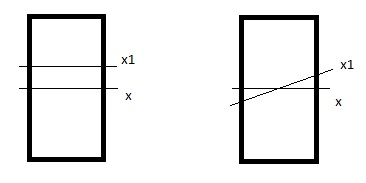
However, we'd like to delve deeper into the topic of balancing and warn customers against misunderstanding certain concepts. Every wheel is balanced both statically and laterally. Static imbalance occurs when the axis of rotation "wants" to move beyond the center of the wheel. Lateral imbalance occurs when the axis of rotation "wants" to deviate from the vertical. This situation is illustrated in the illustration below, where x is the correct axis of rotation, and x1 is the apparent axis of rotation, displaced by the underbalance:
Wheel balancers used in workshops are designed to eliminate both static and lateral underbalance with just a few weights. However, it's important to remember that after removing a wheel from the balancer and mounting it on the vehicle, the axis of rotation may shift slightly due to the rim's center bore not being perfectly aligned with the hub (if this were the case, it would be difficult to remove the wheel after the season). Therefore, even a perfectly balanced wheel on the balancer can cause vibrations in the bodywork while driving. To compensate for this effect, the wheel should be rebalanced on the vehicle. However, vibrations in such situations are very rare, but possible. We would also like to discuss the optimization of tire alignment. Sometimes, when mounting wheels, the tire fitter indicates that the rims or tires may be worn because a large number of weights were required to balance the wheel correctly. Unfortunately, tire fitters often forget that this effect can be compensated for by offsetting the tire relative to the rim. Neither a rim nor a tire is ever perfectly round or straight. The manufacturing process of each product is governed by certain standards and quality controls that establish acceptable production tolerances. Tire use can also lead to serrations or flattening in a single spot. This causes both the rim and tire to have their factory underweight, as specified by the manufacturer. In the unlikely event that the wheel assembly process is incomplete, the aforementioned underweights can "cumulate" and require correction with a large number of weights. In such a situation, however, the tire should be disassembled and rotated relative to the rim by several dozen degrees. This will cancel out any manufacturing or operational defects, significantly reducing the number of weights required.
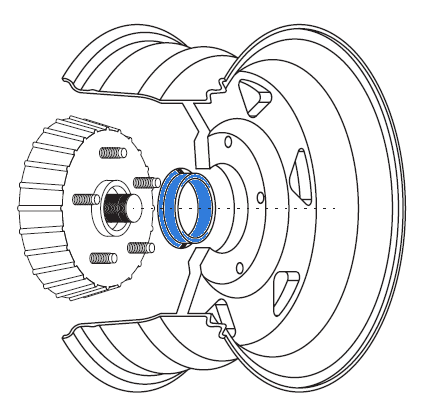 Play between the car hub and the mounted rim - In the case of the centering ring used, make sure that there is no play, both between the centering ring and the car hub and the centering ring and the centering hole in the rim.
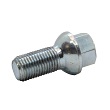
- Using inappropriate screws/nuts for securing the rim - Please make sure that you are using mounting screws dedicated to the mounting socket that the rim has.
Defective and damaged tires during use - Even new tires, like any product, can be defective. Deviations can be clearly seen after mounting the tire on the rim or when rotating it on a wheel balancer. It's important to check for bulges in the tires. Interestingly, even improper storage can cause vibrations, but this should subside after a few hundred kilometers.
To learn how to properly store tires, read our article: Some tips on how to store rims and tires
- Defective Aluminum Rims - Rim companies emphasize that the product's technical condition should be checked before mounting the tires. Simply rotate the rim to observe any deviations. Unfortunately, some tire fitters do this incorrectly. The most popular aluminum rims are made using the so-called low-pressure method. The rim's protective lip, which prevents the tire from slipping, may not be perfectly cast, as the tire sits below it. Observing the rim from the front, it may seem that the rim doesn't adhere to the wheel's shape when rotating. Furthermore, currently available rims with various color finishes can be misleading. Experts advise only observing the tire mounting area. This area is additionally milled, so the casting shape is corrected. Complaints related to this occur in fewer than 1 in 1,000 cases. Below, you can see exactly where to check for a bent rim. We emphasize, however, that the outer lip alone does not define a rim as defective or functional. This element is designed to hold the tire on the rim, and any visual defects on this element disappear once the tire and then the entire wheel are mounted on the car. The same applies to uneven paintwork on this element. This creates an oval-shaped wheel effect, but we can only notice this by observing the rim rotating, without any movement in any other plane. Therefore, it won't be noticeable on a moving car, but the effect can create a false sense of a crooked rim during balancing. We should also pay attention to the surface of the rim that contacts the wheel hub and the balancer's mounting elements. Any contamination or post-production aluminum chips should be removed from these surfaces. The rim must always fit perfectly against the wheel hub.
Warped rims – Aluminum rims are much more resistant to dynamic impacts and more durable than steel rims. However, aluminum rims often have lower-profile tires, which make bumps and vibrations more noticeable due to reduced shock absorption. Rim damage can occur in a number of ways:
- hitting the curb,
- driving into a larger hole in the asphalt,
- during transport by courier company.
This is often not caught during tire mounting by the tire fitter. Before mounting the tires, check for any visible mechanical damage.
- Warped brake discs – This will be noticeable when braking. One cause that few people pay attention to is washing hot wheels, which can cause the brake disc to warp due to the sudden temperature change. Severely warped discs will generate vibrations while driving.
- Damaged support bearings, play in the steering system, and severely worn shock absorbers – A worn-out shock absorber is unable to dampen vibrations. This can be noticeable when driving over uneven terrain and accelerating quickly.
- Worn, unbalanced driveshaft joints – Everyone can recognize a worn outer joint (you can hear it when turning), while the inner joint becomes noticeable under heavier loads during acceleration, causing the entire car to vibrate. The vibrations should subside after releasing the throttle.
Are you having trouble with steering wheel vibration while driving? React as soon as possible!
Unless you're a motoring expert, if you notice vibrations in the steering wheel, you should immediately seek help from a mechanic. Left untreated, these symptoms can have a significant impact on your wallet, including accelerated wear and tear of the steering system, suspension components such as tie rod ends, control arms, and electronics. Tire wear and tear can also occur, and even damage to the engine mounts can occur. This isn't to mention situations where a bump on the tire is to blame for the vibrations; such an incident can result in loss of control, which is a short step away from a road accident.