



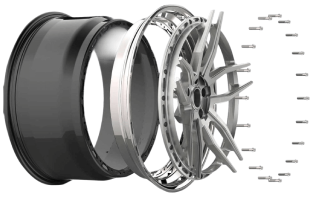
 Modern design
 Perfect fit
 High durability
 Free shipping within 24 hours
 Individual project
 Dedicated specjalist



What do speed limits on Polish roads depend on?
Speed limits are one of the cornerstones of road safety. While many drivers consider them simply a number on a sign, in practice, speed limits in Poland are based on a complex system of factors: road type , built-up or unbuilt areas , vehicle type , and even the specific traffic organization in a given location. Polish road regulations in this area are among the most complex in Europe—primarily due to the extensive road classification and varying maximum speeds for passenger cars, trucks, and motorcycles.
Ignorance of the rules doesn't protect you from consequences. Speeding today isn't just a matter of penalty points and strict fines , but above all, a real threat to the health and lives of road users. In this article, we'll clarify the issue: explaining what determines speed limits on Polish roads, who sets them, and when exceptions apply. This will make it easier to navigate the regulations—and the roads themselves.

What do speed limits in Poland depend on? Key factors
The answer to the question of what determines speed limits on Polish roads isn't simply a matter of reading a number on a round sign. The speed limit system is logically structured and rests on several fundamental pillars: road type, its technical standard, and whether you're driving in a built-up area or outside it. These elements determine the maximum speed you're allowed to drive—even if there's no additional speed limit sign in a given location.
Road type and its infrastructure – why is a motorway not an expressway?
The first key factor is the types of roads in Poland. Motorways, expressways, national roads, and regional roads differ not only in name but primarily in technical standards and traffic organization.
The speed limit depends on, among other things:
- number of roadways (single or dual carriageway),
- number of lanes,
- presence of collision intersections,
- access to the road (interchanges vs. direct exits).
For example, on a highway, a passenger car can travel at speeds of up to 140 km/h, while on a dual carriageway, it can travel up to 120 km/h, and on a single carriageway, it can travel up to 100 km/h. The difference stems from the level of infrastructure safety and traffic predictability. This demonstrates that speed limits on roads are not set at random —they are closely linked to the design and intended use of the route.
Built-up vs. undeveloped areas – the foundation of Polish law
The second pillar of the speed limit system is the division into built-up and unbuilt areas . This is one of the most important elements that every driver should know.
Currently, the speed limit in built-up areas is 50 km/h 24 hours a day . It's worth remembering that a few years ago, there was a distinction between day and night ( 60 km/h at night ), but the regulations have been unified. Today, the 50 km/h limit applies both day and night.
How to recognize the beginning and end of such an area?
- sign D-42 indicates entry into a built-up area,
- sign D-43 informs about its completion.
It is these signs that determine when the built-up area changes – the speed, even if we do not see additional speed limit signs.
Once you pass the sign marking the end of a built-up area, the higher limits appropriate to that type of road apply – unless otherwise indicated.
Understanding this basic structure of the regulations can help you avoid many mistakes. In the following sections, we'll look at the specific limits for different road categories and vehicle types.
Speed limits for cars and motorcycles
Passenger cars and motorcycles constitute the largest group of road users. Regulations specifically specify the highest speed limits for these vehicles. However, it's worth remembering that the maximum speed depends not only on the type of road, but also on its construction and the number of lanes.
Below we present the current limits in force in Poland for passenger cars and motorcycles, assuming no additional restriction signs.
Motorways and expressways – where will we go fastest?
The highest permissible values apply to roads with the highest technical standard.
- The maximum speed on the highway for passenger cars and motorcycles is 140 km/h.
- On the dual carriageway expressway the limit is 120 km/h.
- On a single-carriageway expressway – 100 km/h.
These differences result from the route's design. Motorways have grade-separated interchanges , wide lanes , an emergency lane , and full separation of traffic directions . Expressways – especially single-carriageway ones – do not always offer the same level of safety, hence the lower limit.
In practice, questions like " how fast can you drive on an expressway " arise very often. It's crucial to distinguish whether the road has two separate carriageways or just one common lane for both directions of traffic.
Roads outside built-up areas – when 90 km/h and when 100 km/h?
Outside built-up areas the basic rule is as follows:
- 90 km/h – on standard single-carriageway roads,
- 100 km/h – on dual carriageways with at least two lanes in each direction.
This means that most of the classic national and provincial roads outside the city are subject to a 90 km/h limit, unless there are additional speed limit signs.
The higher limit of 100 km/h applies to roads of a higher standard – with a clear separation of traffic directions and greater capacity.
Phrases like "out-of-town speed limits" or "speed limits on country roads" often lead to confusion because drivers assume that the road category itself (e.g., "country") automatically implies a specific limit. In reality, the road's design and signage are decisive.
Vehicle type and speed limit – who does different limits apply to?
Although road signs show a single speed limit, not every vehicle can travel at the maximum speed allowed for a passenger car. Polish road traffic regulations clearly differentiate limits depending on the vehicle type, its weight, and whether it forms a combination vehicle (e.g., with a trailer).
This is crucial because many drivers assume that just because a highway speed limit is 140 km/h, it applies to everyone. In practice, this isn't the case.
Cars with trailers and trucks (over 3.5 t)
If we are traveling in a combination of vehicles, i.e. a car with a trailer, lower limits apply.
For a passenger car with a trailer, the permitted speeds are:
- 80 km/h on the highway,
- 80 km/h on the expressway,
- 70 km/h outside built-up areas on other roads.
Similar restrictions apply to many heavy goods vehicles over 3.5 tonnes. In their case, the limits for trucks are lower due to, among other things, their higher gross weight and longer braking distance.
Why does mass matter?
The greater the mass of the set, the:
- longer stopping distance,
- greater inertia during a sudden maneuver,
- higher risk of loss of stability (especially in crosswinds or sudden braking).
Therefore, the permissible speed of a vehicle combination is limited by law – even if the road infrastructure would allow for faster driving.
Buses – special permissions on expressways
Buses are a special category of vehicle. Their standard speed limit outside built-up areas is 90 km/h. However, there are exceptions.
A bus may travel at a speed of up to 100 km/h on a motorway and expressway, provided that:
- is structurally adapted to such a speed,
- meets certain technical requirements (including equipment with a speed limiter),
- has appropriate markings and meets the approval requirements.
This means that the speed of a bus on the highway is not always the same – it depends on meeting specific requirements.
In the context of the topic of "speed limits for buses", it is worth remembering that the regulations take into account both passenger safety and the nature of public transport.

Special zones – residential zone and speed limit zone
Not all speed limits are dictated by road category. The Polish legal system also includes so-called special zones, where pedestrian safety and the local traffic pattern are paramount, rather than road capacity. In such areas, drivers must change their mindset – it's not the maximum permissible vehicle speed that matters, but the protection of vulnerable road users.
Residential zone (sign D-40) – only 20 km/h

The residential zone is one of the most restrictive solutions in Polish regulations. It is indicated by the D-40 sign.
What does this sign mean in practice?
- the maximum speed in a residential area is 20 km/h,
- pedestrians can move along the entire width of the road,
- pedestrians have absolute priority over vehicles,
- Parking is only allowed in designated areas.
This isn't an "ordinary housing estate," but a space where car traffic is subordinate to pedestrian traffic. Therefore, the D-40 speed sign represents a real change in the rules, not just a lowering of the speed limit.
Many drivers disregard the 20 km/h speed limit, treating it as symbolic. However, this is one of the places where exceeding the speed limit can have particularly serious consequences – both legally and in terms of safety.
"Pace 30" zone and local speed limits
So-called Speed 30 zones are becoming increasingly common in cities. These are areas where the maximum speed limit is 30 km/h – usually in city centers, near schools, and in dense residential areas.
In such places, the legal basis is the B-33 speed limit sign, a sign that indicates a specific speed limit. Importantly:
- sign B-33 overrides the general provisions,
- valid until the nearest intersection (unless otherwise indicated),
- may apply to the entire zone if it is introduced with appropriate signage.
This means that even if you are outside a built-up area, the speed limit sign takes precedence over the speed limit dictated by the type of road.
Phrases like "road signs speed" or "speed limit sign" often arise in the context of a question about whether the sign or the general rule applies. The answer is clear: the sign always takes precedence over the general limit.
Consequences of speeding – fines and penalty points
Ignoring speed limits is one of the most costly road traffic offenses today. The current penalty system has been significantly tightened – both in terms of fines and the number of penalty points. The aim of these changes was to curb the most dangerous behaviors, especially significant speeding in built-up areas.
In practice, exceeding the limit means not only a speeding ticket, but often also a real risk of losing your driving license.
New fine schedule – how much does recklessness cost?
The current 2026 schedule of speeding fines in Poland introduces specific thresholds for fines and points, which apply to every reading from the measuring device - both by the police and speed cameras.
Below we show how much reckless driving costs depending on how many km/h you exceed the limit:
- up to 10 km/h – fine from PLN 50 and 1 penalty point,
- 11–15 km/h – from PLN 100 and 2 penalty points,
- 16–20 km/h – from PLN 200 and 3 penalty points,
- 21–25 km/h – from PLN 300 and 5 penalty points,
- 26–30 km/h – from PLN 400 and 7 penalty points,
- 31–40 km/h – from PLN 800 (recidivism PLN 1,600) and 9 penalty points,
- 41–50 km/h – from PLN 1,000 (recidivism PLN 2,000) and 11 penalty points,
- 51–60 km/h – from PLN 1,500 (recidivism PLN 3,000) and 13 penalty points,
- 61–70 km/h – from PLN 2,000 (recidivism PLN 4,000) and 14 penalty points,
- over 70 km/h – from PLN 2,500 (recidivism PLN 5,000) and 15 penalty points.
Even a small excess means points are added to the driver's account, which add up to a possible loss of driving privileges.
Recidivism rules are also important. If a driver commits the same offense again within two years (e.g., exceeding the speed limit by 31–40 km/h), the fine will double , although the number of points remains the same.
In practice, this means that even if the road infrastructure allows for high limits, a speeding fine in 2026 could easily exceed several thousand zlotys, especially in the case of repeat offenses or serious violations.
Loss of driving license for 3 months – "50+" regulation
One of the most severe sanctions is the administrative suspension of your driving license .
If a driver exceeds the speed limit by more than 50 km/h in a built-up area, a police officer will confiscate the driving license on the spot and the staroste will issue a decision to confiscate it for 3 months.
This is the so-called "50+" provision.
In practice, this means that:
- driving 101 km/h in a place where the speed limit is 50 km/h,
- may result in immediate loss of privileges.
If the driver decides to drive despite the ban, the detention period may be extended to 6 months and, in extreme cases, even to the withdrawal of the driving license.
Phrases such as "driving license taken away for speeding" or "loss of driving license for 50 km/h" are not theoretical - they are real consequences that can affect every driver.
It's worth remembering that the penalty system isn't solely punitive. Its goal is to curb the most dangerous behaviors and improve safety on Polish roads.
Frequently asked questions about speed limits in Poland (FAQ)
Mateusz Mentel
Author of the entryHe has been associated with LadneFelgi.pl since 2024. He specializes in aluminum wheels and modern automotive solutions. His day-to-day responsibilities include creating expert articles, marketing activities, content creation, and managing social media channels.