



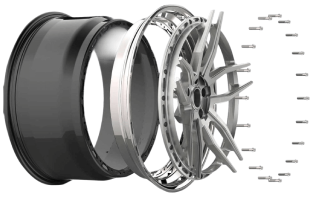
 Modern design
 Perfect fit
 High durability
 Free shipping within 24 hours
 Individual project
 Dedicated specjalist





When can you make a U-turn at an intersection?
Making a U-turn at an intersection is one of those maneuvers that, in practice, raises more questions than one might think. Many drivers are unsure when a U-turn is permitted and when it's prohibited , especially if there are additional signs or traffic lights at the intersection. As a result, some people forgo the maneuver "just in case," while others perform it illegally, risking a U-turn fine and—more importantly—endangering other road users.
Properly making a U-turn at an intersection isn't just a formal matter. It also contributes to road safety and traffic flow, especially in cities with heavy traffic. A simple misinterpretation of the S-3 signal, misreading a vertical sign, or ignoring the horizontal markings can create a dangerous situation.

General rules for making a U-turn at an intersection – what do the regulations say?
The basic principle of the regulations is simple: U-turns are permitted wherever they are not expressly prohibited and where the maneuver can be performed safely. This means that the intersection itself is not, by definition, a prohibited area. Road signs, traffic signals, and the realistic possibility of performing the maneuver without endangering other road users are crucial.
In practice, turning at an intersection is governed by the principle of extreme caution. Drivers must not only properly assess the road markings but also the road conditions: visibility, traffic density, and the path of other vehicles.
U-turn and left turn – why are they not the same?
A common source of confusion is the conflation of a U-turn with a left turn. However, while every U-turn maneuver involves a left turn, not every left turn gives rise to the right to make a U-turn.
The difference is fundamental:
- a left turn means a change of direction within the intersection,
- A U-turn is a 180-degree change in direction and return in the opposite direction.
In practice, it may happen that a left turn is permitted at an intersection, but at the same time a U-turn is prohibited – for example, based on a vertical sign.
Another key issue is priority when making a U-turn . Drivers making this maneuver are obligated to yield the right-of-way:
- vehicles coming from the opposite direction going straight ahead,
- vehicles turning right from the opposite direction,
- pedestrians on the crossing.
That is why turning left and making a U-turn is not only a matter of intersection geometry, but above all of responsibility and assessment of the road situation.
Where is it strictly forbidden to turn around?
The regulations clearly indicate places where turning is prohibited under all circumstances (unless a special place has been designated for this purpose).
Where can you not turn around?
- in the tunnels,
- on bridges and viaducts,
- on highways (except in designated areas),
- on expressways outside junctions,
- on one-way roads,
- in places where there is a clear prohibition on turning.
These restrictions stem directly from concerns about safety and traffic flow. No U-turns – the regulations in these locations are absolute, as such maneuvers could lead to very dangerous situations.
In the next part, we will analyze how to interpret specific vertical signs and light signals – because these are the ones that most often raise the greatest doubts among drivers.
Road signs and U-turns – when is a maneuver prohibited?

Vertical signs raise the most questions when making a U-turn. They primarily determine whether a driver can make a 180-degree turn. In practice, many fines result not from a lack of knowledge of the general rules, but from misinterpreting a specific sign.
Below we discuss the most important situations in which signage clearly excludes U-turns.
Sign B-21 "no left turn" and B-23 "no U-turn"
This is the most common interpretation “trap”.
Sign B-21 – No Left Turn – automatically prohibits U-turns. Why? Because a U-turn always begins with a left turn. Therefore, if a left turn is prohibited, you can't make a U-turn either.
Sign B-23 – No U-turns – works differently. It only prohibits a 180-degree change in direction, but still allows a regular left turn. This is a crucial difference that many drivers forget.
To sum up:
- sign B-21 – turning is prohibited,
- sign B-23 – turning around is prohibited, but turning left is allowed.
It's also worth remembering the scope of the signs. Generally, they apply to the nearest intersection, unless a sign indicating a different scope is placed underneath the sign.
The phrase "no left turn sign and no u-turn" appears very often in search engines - and rightly so, because this is where drivers most often make mistakes.
Mandatory signs (C-1 to C-5) – silent no-turn sign
In addition to prohibition signs, there is another group that indirectly excludes turning – mandatory direction signs.

Examples:
- C-1 – driving to the right before the sign,
- C-2 – driving to the right after the sign,
- C-3 – driving to the left before the sign,
- C-4 – driving to the left after the sign,
- C-5 – order to drive straight.
If the sign requires driving only in a specific direction, turning is prohibited, even if there is no separate B-24 sign.
For example, at sign C-5 (go straight), a driver may neither turn left nor make a U-turn. Similarly, at a sign requiring right-hand drive only, making a U-turn is contrary to the applicable traffic direction.
This is a so-called "silent prohibition," and it's not always intuitive. Searches like "mandatory signs and U-turns" or "going straight and U-turns" show that many drivers are unaware of this.
Traffic lights and directional arrows – the key to the correct maneuver
Traffic light intersections are where drivers most often have doubts about whether they can make a U-turn. Errors usually result from confusing a regular green light with a directional signal and from misinterpreting the arrows on the road. However, it is the traffic lights and road markings that primarily determine whether a maneuver is permitted.
Directional signal S-3 – when does the arrow allow you to turn around?

It is crucial to distinguish between a standard green light and the so-called S-3 directional signal.
- A regular green light (round) allows you to drive in permissible directions unless signs prohibit it.
- The S-3 direction indicator displays a green arrow indicating a specific direction of travel – and only this direction is permitted.
And this is where the most common mistake occurs.
If the S-3 signal only shows a left arrow, you are not allowed to make a U-turn. The arrow indicates exactly what it indicates – a left turn, not a 180-degree change of direction.
So when is a U-turn permitted at a directional signal? Only when the signal permits such a maneuver—that is, when the arrow indicates the possibility of a left turn combined with a U-turn (usually in the form of an appropriate symbol permitting both maneuvers).
P-8 horizontal markings – arrows on the asphalt
Equally important are the horizontal markings, i.e. arrows painted on the lane.
- P-8b – left directional arrow – means only left turns are allowed.
- P-8c – left arrow with U-turn – allows both left turns and U-turns.
If the lane only has a left arrow (P-8b), turning is not permitted. However, a marking permitting both directions clearly indicates that the lane is also a turn lane.
What if the vertical signs and horizontal markings seem to conflict? According to the road sign hierarchy, traffic lights have priority, followed by vertical signs, and then horizontal markings. This means that if a directional signal prohibits a U-turn, an arrow on the roadway does not grant the right to perform a U-turn.
Therefore, when analyzing intersection lights and U-turns, it's always important to consider the full context: traffic lights, signs, and lane markings. Only their combined interpretation provides certainty as to whether the maneuver complies with the regulations.
Specific situations: turning around roundabouts and junctions

Not all U-turns take place at a classic signalized intersection. In practice, drivers often use roundabouts and special changeover points on dual carriageways. These solutions are designed to improve safety and traffic flow – provided they are used correctly.
How to safely turn around at a roundabout?
In practice, turning around a roundabout is one of the safest ways to change direction. Roundabouts are designed to reduce vehicle speed and minimize the risk of head-on collisions.
How to perform the maneuver correctly?
- before entering, you must take the appropriate lane well in advance (usually the left one if the roundabout has multiple lanes),
- at the roundabout, we move according to the horizontal and vertical markings,
- we signal our intention to exit only before leaving the roundabout,
- we give way to vehicles already on the roundabout (if the roundabout priority rule applies).
Turning around at a roundabout means, in practice, driving around the central island and leaving the intersection via the exit from which you entered – but observing the rules of the roundabout.
Particular caution should be exercised at turbo-roundabouts, where changing lanes within the roundabout may be impossible or prohibited. In such locations, it is crucial to position your vehicle in the appropriate lane before entering.
Turning on roads with green belts ("switches")
Dual carriageways with a central reservation often feature designated change-of-direction areas, commonly known as "switches." These are special sections that allow for safe U-turns on the dual carriageway.
To perform the maneuver correctly:
- turn on the turn signal well in advance,
- pull into the designated turning lane,
- position the vehicle parallel to the road axis, without blocking the straight-ahead lane,
- give way to vehicles approaching from the opposite direction.
You must not make a U-turn anywhere on the median unless it is designated for that purpose. A maneuver performed outside of a designated U-turn may be considered a violation and create a serious hazard.
It's worth remembering that while road infrastructure increasingly facilitates changing direction, the responsibility for safely completing the maneuver always rests with the driver. Even in areas formally permitted, extreme caution must be exercised and the behavior of other road users anticipated.
Consequences of errors – safety and fines
U-turns are a maneuver that, if performed incorrectly , can lead not only to stressful situations on the road but also to serious consequences—both in terms of safety and financial penalties with penalty points . Knowing the risks of making a mistake and the penalties for making it can protect a driver from a ticket and the loss of their driving license.
Dangers resulting from improper turning
Improper U-turns at intersections are primarily a danger to other road users.
- The most serious risk is a collision with oncoming vehicles , especially if the driver misjudges the distance or speed of oncoming vehicles.
- Danger also arises when a driver performs a manoeuvre without giving way to vehicles or pedestrians, which may result in forcing the right of way when making a U-turn and lead to a collision.
Each collision of this type involves not only repair costs and fines, but above all, the risk of injury to the driver, passengers and other road users.
2024/2025 fine schedule for improper U-turns
Current road traffic regulations provide for specific penalties for errors when making a U-turn – both financial and point penalties.
- For making a U-turn in a place where it is prohibited or in a way that endangers safety or obstructs traffic, the driver may be fined from approximately PLN 200 to PLN 400 and 5 penalty points.
- Additionally, if the maneuver causes a real danger or collision, the officer may classify it as a more serious violation, which may result in a higher penalty and additional points.
- In the penalty points table, violating the no-turn rule normally results in 5 penalty points , while other errors related to signalling and dangerous maneuvering may also result in additional points.
It is worth remembering that from March 2022, the general rates of fines in the road traffic system have increased significantly, with the maximum penalty for other serious offenses being up to several thousand zlotys.
Knowing these regulations and the consequences of breaking them is not only a matter of avoiding a ticket for making a U-turn in 2026, but above all, an element of conscious and safe driving that protects the driver and other road users.
Frequently Asked Questions (FAQ) – Turnaround in a Nutshell
Mateusz Mentel
Author of the entryHe has been associated with LadneFelgi.pl since 2024. He specializes in aluminum wheels and modern automotive solutions. His day-to-day responsibilities include creating expert articles, marketing activities, content creation, and managing social media channels.