



 Modern design
 Perfect fit
 High durability
 Free shipping within 24 hours
 Individual project
 Dedicated caregiver





Flat tire on the road – what to do?
A flat tire is a situation that can happen to anyone on the road. What can you do?
Learn how to handle such a breakdown while maintaining complete safety on the road. Depending on the type of damage and the road on which it occurred, you'll have to choose between tackling it yourself, using a repair kit that includes a tire repair cord, or calling in professional help, which will undoubtedly be more expensive.
SOS on the road: how to deal with a flat tire in an emergency?
Even though cars are becoming increasingly modern and roads are in better condition, a breakdown on the road is bound to happen to every driver sooner or later. How you handle such a challenge depends on what exactly happened.
The first and most important action if you notice something wrong with your car while driving is to safely slow down and stop.
If one of your tires is damaged, you have several options for dealing with the situation. These include:
- calling a tow truck – in the event of a crack or tear, this will be necessary – this is definitely the most expensive option;
- calling a specialist with mobile tire repair – such professional help will deal with most tire damage;
- replacing the tire on the road with a spare – provided, of course, you have the spare tire, jack, wrench and pump with you if the tire is not properly inflated – this is the cheapest option;
- repairing a wheel yourself – if you don’t have a spare wheel, in most cases you can also repair it on the road using a repair kit – such a kit is much lighter and smaller than an extra wheel, so it is often carried instead.
Fixing a flat tire can be the quickest and cheapest solution. So if you don't want to spend unnecessarily large amounts of money on a tow truck or are pressed for time, you should always carry an inexpensive and space-saving tire repair kit with you.
A common question is: is it safe to drive with a flat tire? Driving on a flat tire is a very bad idea. Underinflated tires can quickly damage the tire's sides, requiring the purchase of a new tire, or rather, a new pair for the same axle. Precise steering and braking are also severely limited with low tire pressure, as well as when the car pulls significantly to the side of the flat tire.
Also, remember not to overinflate your tire. Excessive pressure can lead to tire damage and punctures. Each tire is marked with a maximum pressure rating, and you shouldn't exceed that when inflating.
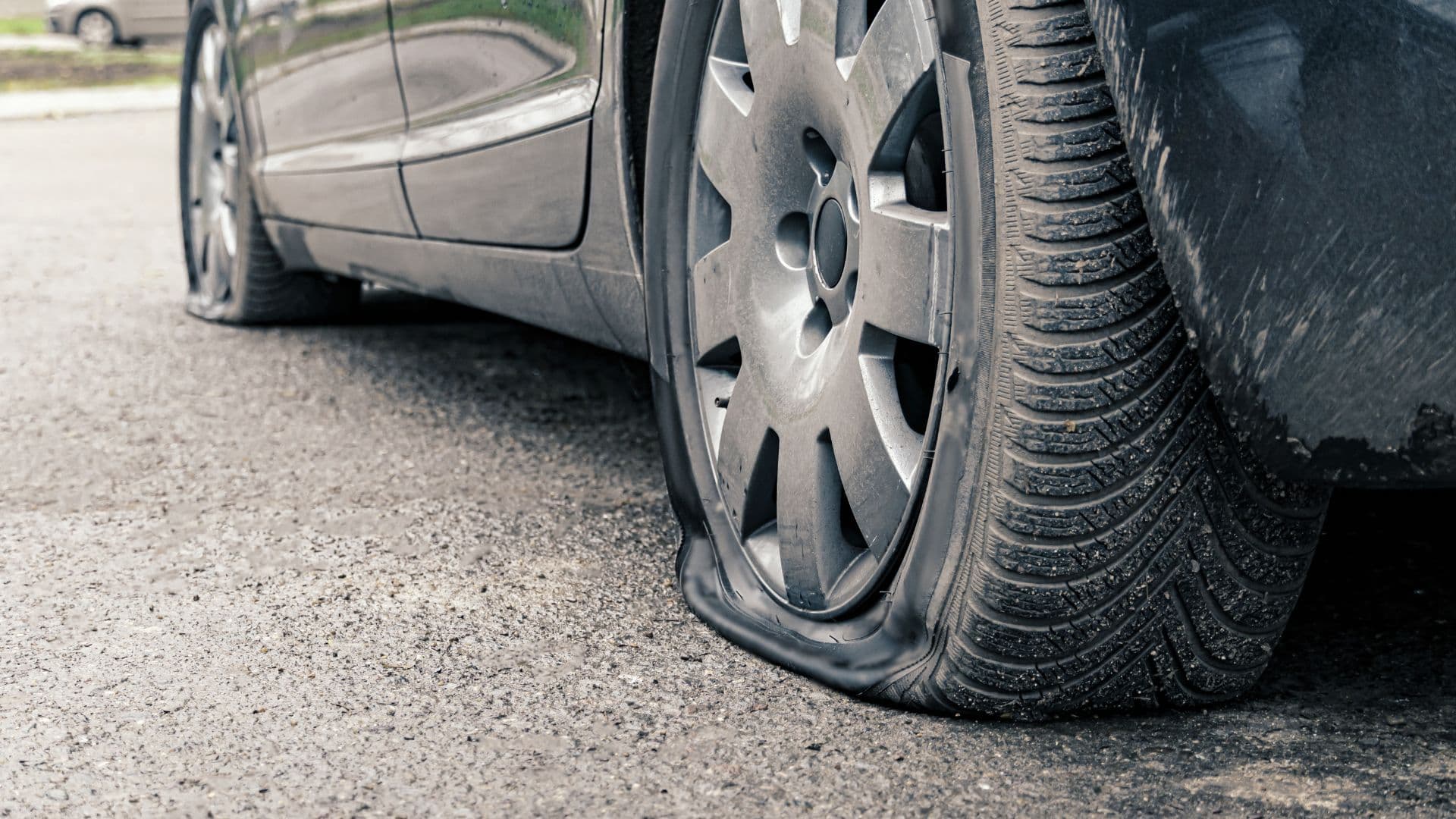
How to locate a tire puncture?
Locating a puncture isn't usually difficult. You should start by examining the tire's sidewalls. If the damage occurs there, you'll need to replace the tire with a spare or call a tow truck; this type of damage is generally not repairable. Next, examine the tire's face.
If you see a nail or piece of glass sticking out, it's simple. How can you tell if a tire is flat if there are no obvious areas of damage? If there are no visible signs of a puncture, you can inflate the tire and try to locate the damage by ear, or by pouring water with leak detection fluid or regular soap over the tire and observing for bubbles. Both methods can be used if you have a pump with you.
Does sealing a tire require a lot of force?
Sealing a tire requires some force, but it's something every driver should be able to handle. A tire repair kit comes with the right tools, making the entire operation a matter of minutes and requiring minimal force. It's significantly easier than changing a tire, which can be avoided this way. Not to mention the time savings you'll achieve with a tire repair kit. A flat tire doesn't have to mean a long road trip, and that's one of the many benefits of DIY roadside repairs.
Road safety – why is it worth carrying a repair kit?
Having a tire repair kit is crucial for your safety on the road. A flat tire often causes a sudden loss of pressure in the damaged wheel. This means you need to stop immediately. This can be an unsafe place. Wide shoulders or densely spaced parking lots are not very common in Poland, as in other countries. In these situations, using a quick repair can be the quickest way to get out of the area. Road safety should be of paramount importance, and it's worth increasing it in this way.
Repair kit in action – how to repair a tire quickly and effectively?
Using the tire repair kit with vulcanizing cord is really simple. The kit includes the following items:
- vulcanizing cord – butyl cord;
- glue – sometimes the rope is already soaked in enough glue and then no additional glue is used;
- awl with handle ;
- spike - cutter.
Of course, you can also use a foam sealant applied to the inside of the tire. This can be done with a spray can that automatically injects the material into the tire, or with a compressor. However, this type of repair has the disadvantage of being a very temporary solution. Immediately after reaching your destination, you should have a proper repair done at a tire repair shop or replace the tires with new ones.
If you've ordered new tires for your car, don't forget about the crucial TPMS pressure sensors , which provide accurate tire pressure readings in real time. Using a tire repair cord (butyl tire repair cord) ensures a permanent repair, ensuring safe driving for thousands of kilometers. Of course, this shouldn't be the end of your tire damage. Only a thorough repair by a tire repair shop will give you absolute confidence that your tire will last a long time.
How to install a repair cord - step by step
Using the repair kit is easy. The steps are as follows:
- determining the location of the tire puncture ;
- removing a nail , screw or other element if it is stuck in the tire;
- Preparing the hole using the pick /cutter included in the kit – this may require some force. The cutter should be inserted into the hole through which the air escapes, preferably at the same angle as the element that damaged the tire. If the kit includes glue, coat the cutter with the glue that will remain on the tire;
- Pushing the butyl cord into the hole using an awl – thread the vulcanizing cord onto the awl from the kit, bending both ends upward. Then, push the awl into the hole so that the cord protrudes a few millimeters above the tire tread. Pull the awl out, and the cord will remain in the tire;
- Removing excess cord – If the excess cord is longer than half a centimeter, trim it with pliers – there's a strong wire inside. As you drive, the wire will be level with the tread.
A flat tire is a serious road hazard, but there are many ways to deal with it. The quickest and most convenient solution in many cases can be to use a tire repair kit and tire cord, which allows for a quick and long-lasting repair. So remember to carry it with you, especially if you don't have room in the trunk for a spare tire.

